
When the C drive becomes full in Windows Server 2012, many users look for ways to adjust partition sizes without losing data. Naturally, nobody wants to spend a long time backing up, recreating partitions, and restoring everything. Windows Server 2012 includes a built-in tool for resizing partitions, but it only works under specific conditions. Disk partition software offers more flexibility, but using unreliable tools could result in system damage and data loss. This article explains how to resize partitions in Windows Server 2012 R2 using both options. Choose the appropriate tool and method based on your disk partition configuration.
1. Which Tool to Resize Server 2012 Partition
There are two kinds of tools to help resize disk partitions in Windows 2012 server: the Windows built-in Disk Management and server partition software.
Advantages of Windows Disk Management:
- It is very fast to shrink and extend a partition because the starting position of the partition will not be changed.
- Shrink and extend partitions without rebooting the server.
Disadvantages of Disk Management to resize partition in Server 2012 R2:
- Only NTFS partitions can be resized.
- Unallocated space can only be generated on the right side while shrinking a partition.
- It cannot shrink a volume beyond the point where "unmovable" files are located.
- Only the partition with adjacent unallocated space on the right can be extended.
- Operations cannot be undone; disk partitions will be modified instantly even if you make a mistake.
- Lack of data protection and other advanced disk partition management abilities.
How to resize partition in Windows Server 2012 R2 via Disk Management:
- Right-click an NTFS partition and select "Shrink Volume", then click the "Shrink" button to decrease the partition using all available space by default, or enter an amount manually.
- Before extending a partition, you must delete the contiguous volume on the right side. After that, right-click this NTFS partition and select "Extend Volume", then simply click Next in the pop-up "Extend Volume Wizard".
The partitions to be deleted and extended must both be primary or both be logical.
If you just want to decrease an NTFS partition to create a new volume, you may try Windows Disk Management. If you want to extend a partition by shrinking another one, Disk Management cannot help you. This is because it cannot generate the required unallocated space to enable the Extend Volume function.
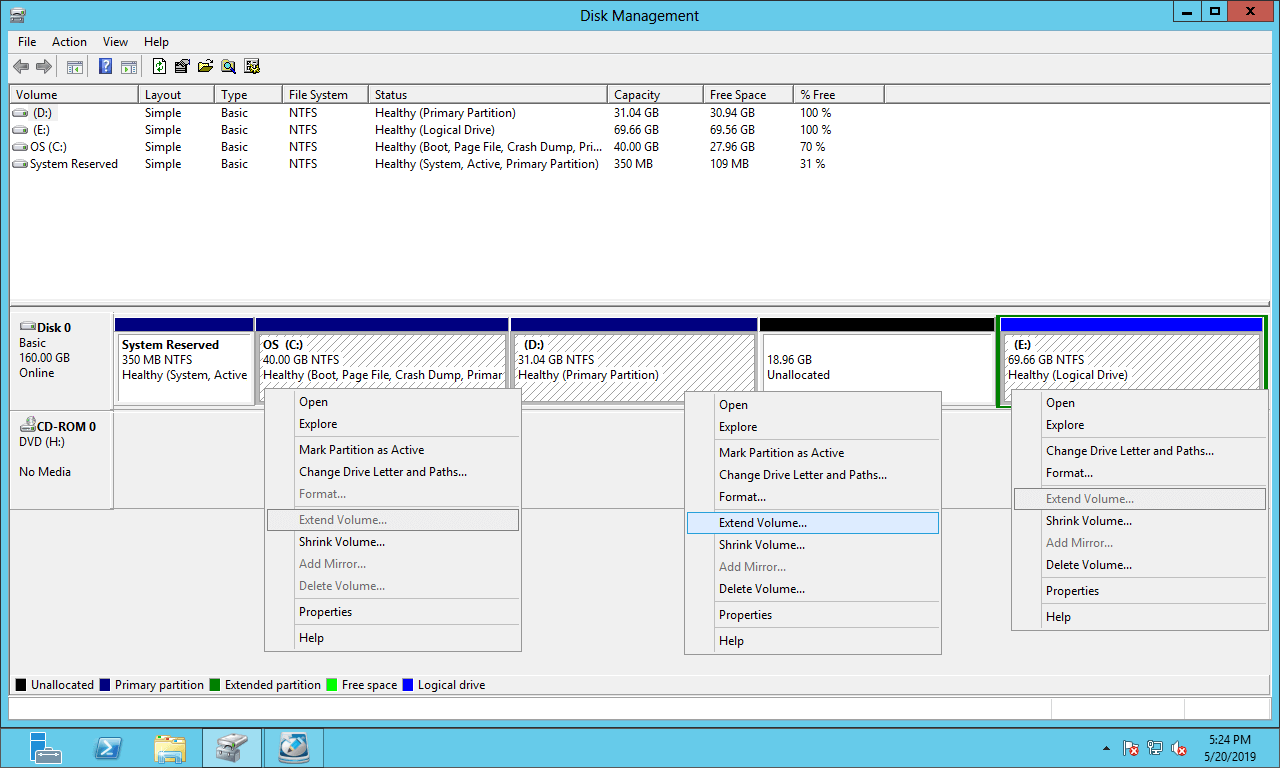
As you see in the screenshot, Disk Management can only extend a partition when there is adjacent unallocated space on the right. After shrinking the D drive, the unallocated space is on the left of the E drive and is non-adjacent to the C drive. This is why many users report that Extend Volume is greyed out in Server 2012.
Better than Disk Management, NIUBI Partition Editor can generate unallocated space on either the left or right side when shrinking a partition. It can extend a partition with either contiguous unallocated space. If there is non-adjacent unallocated space, it can move the partition to make the unallocated space contiguous.
☞ Why There Is Risk When Resizing Disk Partitions
To resize a partition in Windows Server 2012 R2, for example shrinking D to extend the C drive:
- The starting and ending positions as well as other parameters of drive C and D must be modified correctly.
- All files in the D drive will be moved to new locations; all parameters of these files will be changed as well.
- System boot-related files must be updated.
Even a slight error can result in system or partition damage. Many users report issues caused by unreliable partitioning software, such as system boot failures with error messages or a black screen. In some cases, partitions may become RAW, and Windows prompts users to reformat them.
Better than other tools, NIUBI Partition Editor offers innovative technologies to protect your system and data.
- Hot Clone - Clone disk partitions in Windows for backup, migration, and fast disk swapping.
- Virtual Mode - All operations are listed as pending for preview, and real disk partitions won't be modified until you click "Apply" to confirm.
- Cancel-at-Will - If you applied incorrect operations, you can safely cancel the ongoing operations at any stage before completion.
- 1 Second Rollback - If any error is detected while resizing partitions, it can immediately and automatically revert the disk partitions to their previous state.
- Advanced File-Moving Algorithm: Resize and move partitions 30% to 300% faster, saving significant time, especially when handling a large number of files.
These features are both useful and essential when adjusting partition sizes in Windows Server 2012 and other versions.
2. How to Resize Partition in Windows Server 2012 R2 Safely
It is very easy to resize a Server 2012 volume with NIUBI Partition Editor; you just need to click, drag, and drop on the disk map.
Download the server edition, right-click a partition such as D: and select "Resize/Move Volume", then drag the left border to the right in the pop-up window. (Or enter an amount in the box of "Unallocated space before")
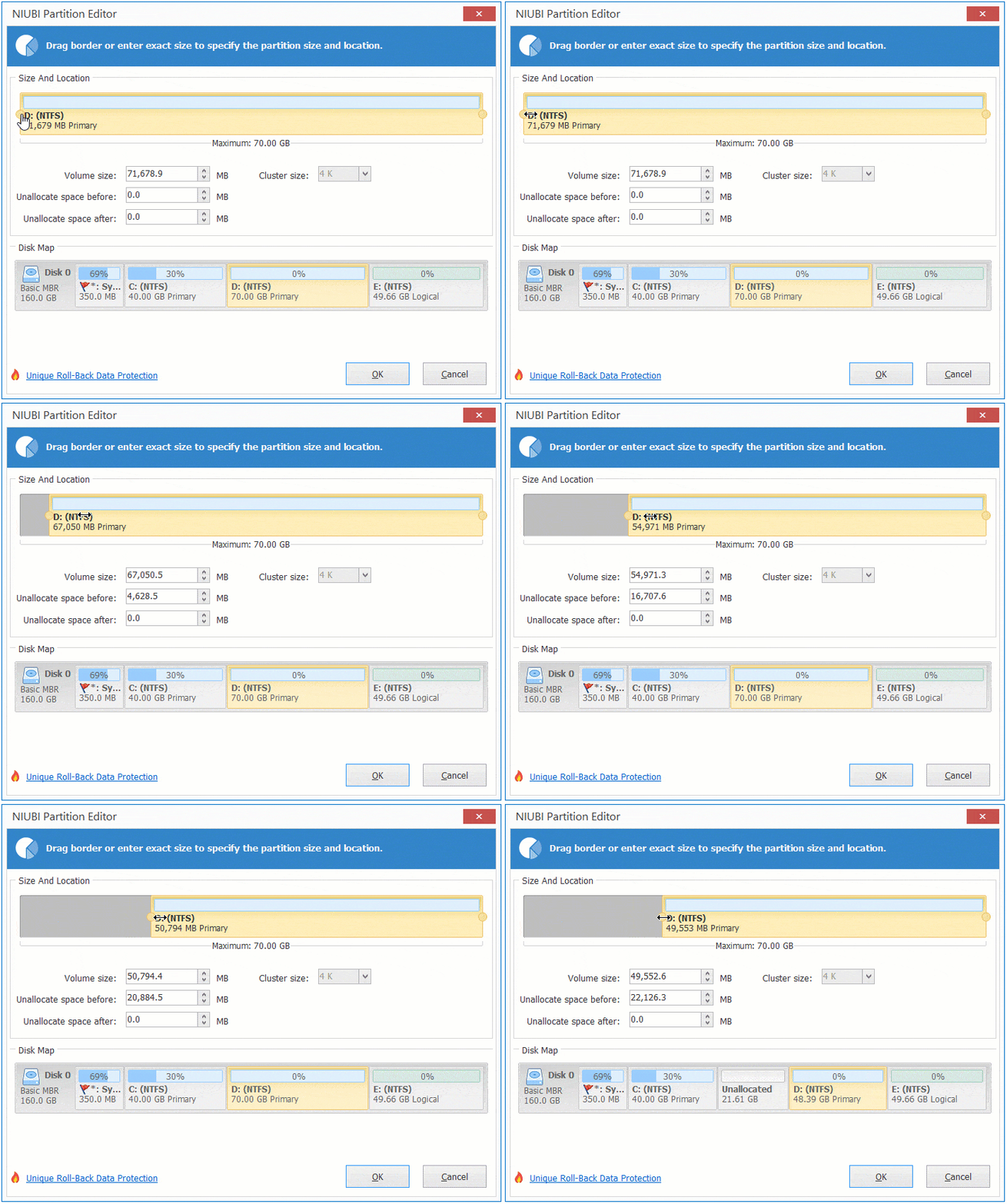
Then, the D drive is resized and some unallocated space is generated on the left side.
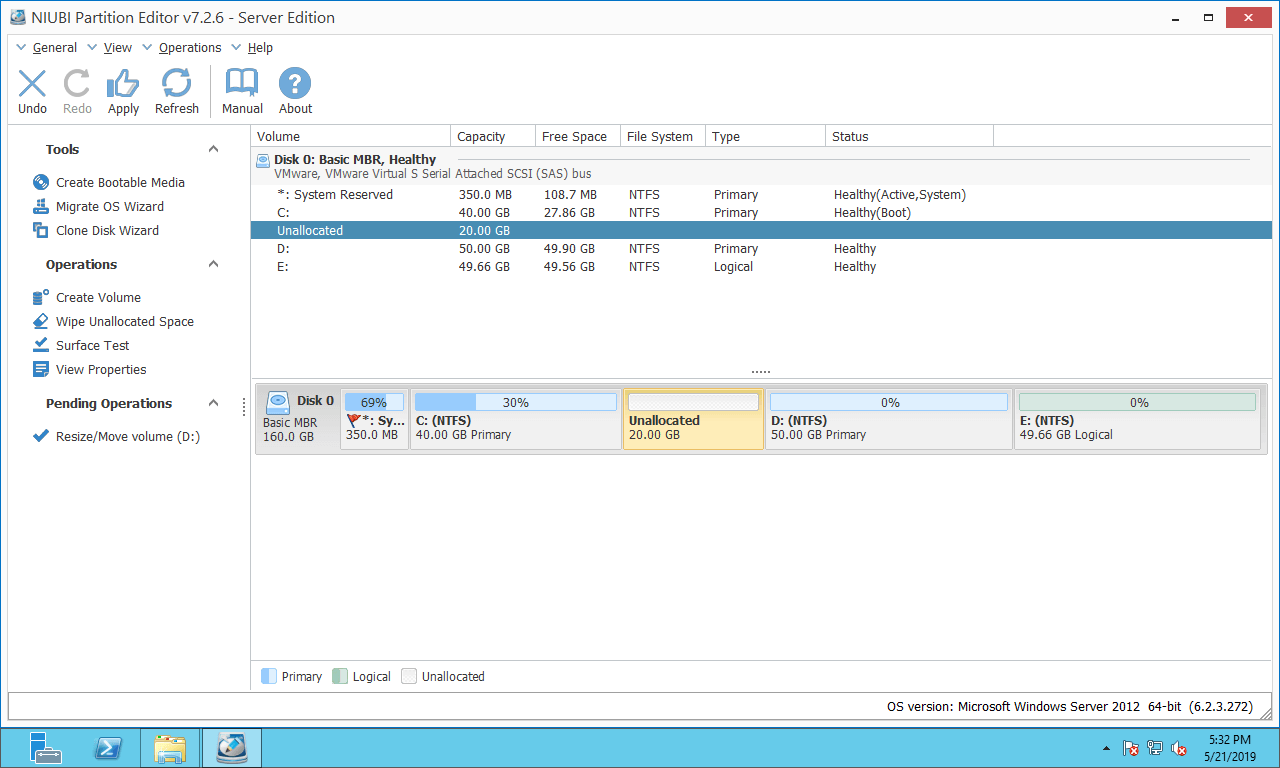
If you drag the right border to the left, unallocated space will be generated on the right side of the D drive.
Right-click the C: drive and select "Resize/Move Volume" again, then drag the right border to the right in the pop-up window.
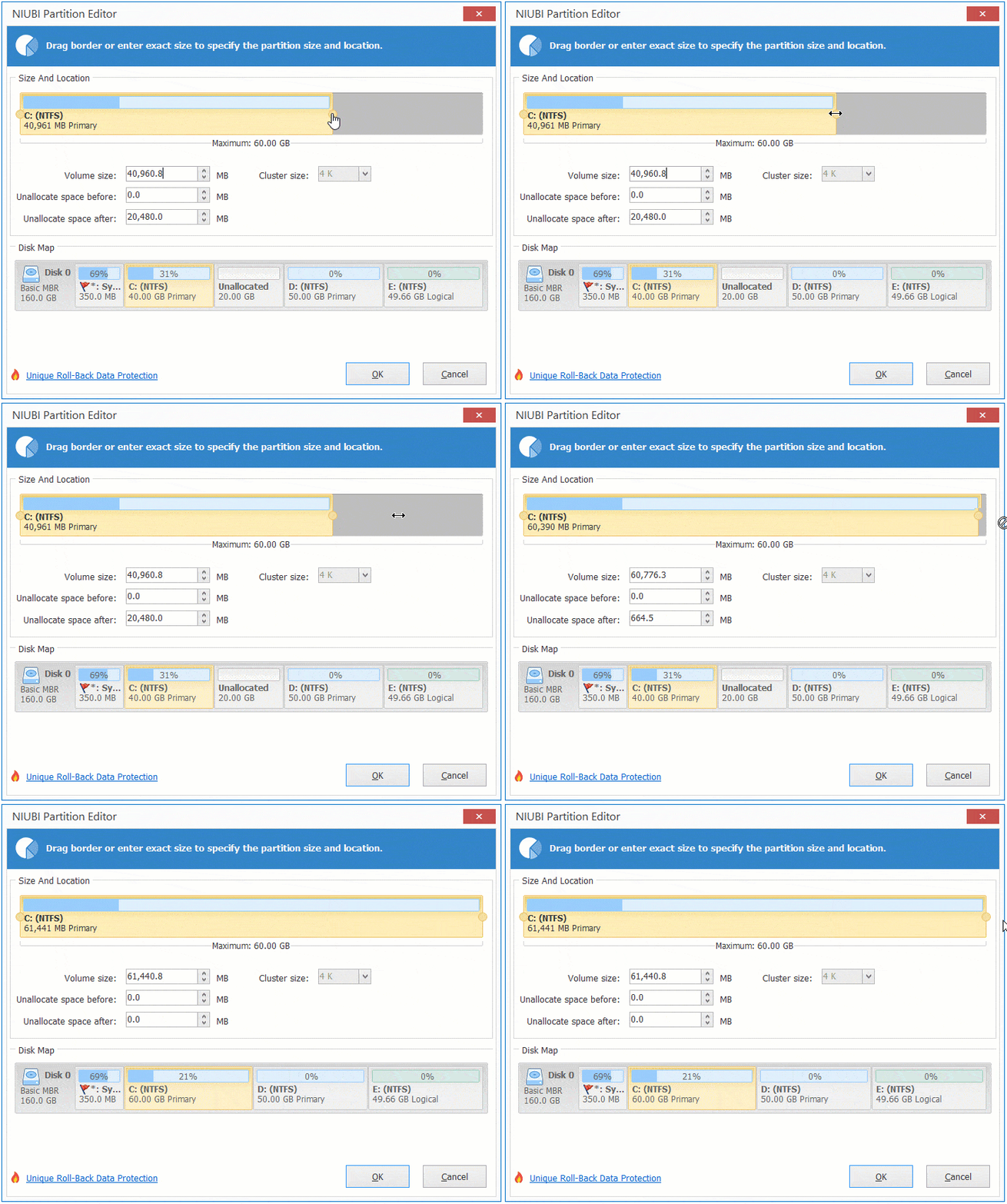
Then, this unallocated space will be added into the C drive.
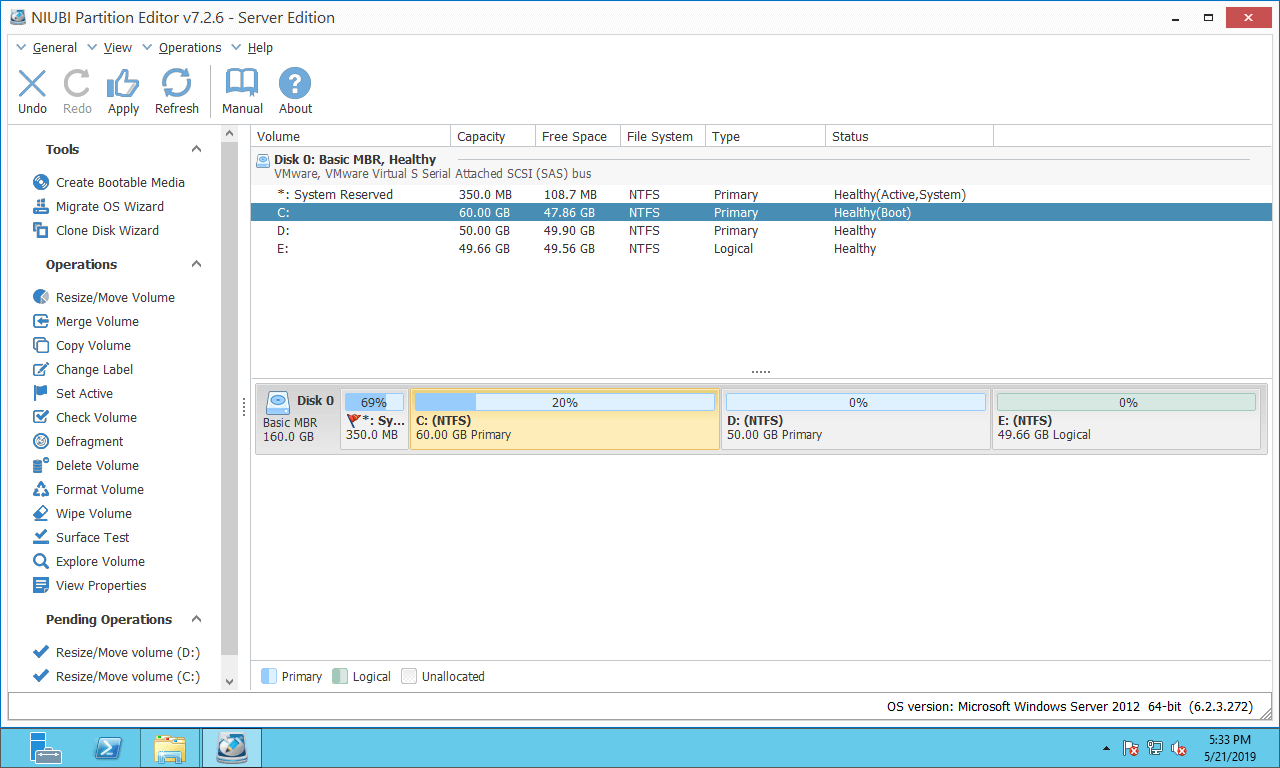
If you want to extend the E: drive, shrink the D drive and generate unallocated space on the right side. Then drag the left border to the left when running "Resize/Move Volume" for the E drive.
To avoid incorrect operations, NIUBI Partition Editor is designed to work in virtual mode. To change real disk partitions, remember to click "Apply" to take effect.
3. Video Guide to Resize Server 2012 Partition
As long as there is free space on the same disk, you can transfer and add it to the partition that you want to expand. Watch the video to see how to resize a partition in Server 2012 R2:
How to extend C drive by shrinking other volumes:
How to extend D drive by resizing C or other volumes:
In some servers, the C drive is getting full, but there is no other partition or no available free space on the same disk. In that case, no software can add space into the C drive from another separate disk. In this situation, you can clone the disk to a larger one and extend partitions with the extra disk space. Follow the steps in the video:
If you want to resize a RAID partition or resize a virtual partition in a VMware/Hyper-V VM, there is no difference. Do not break the array or perform any operations on the RAID controller; just follow the steps above.
Besides resizing partitions in Windows Server 2012/2016/2019/2022/2025, NIUBI Partition Editor helps you perform many other disk and partition management operations.
 © 2009 - NIUBI Technology All Rights Reserved. |